Section I
You Already Know How to Read This
Somewhere around age fifteen you sat in a classroom with a giant chart on the wall.
Columns were families. Rows were periods. Elements that behaved alike stacked on top of each other. Nobody asked you to memorize it. They asked you to learn to read it.
That skill is still in you. It has been idle for decades. Today it goes back to work.
Module 1 gave you the history. Module 2 gave you the current field. Module 3 hands you the instrument.
The Agentic Table is a periodic table of operational functions. Every unit of work an operation runs that a machine can now run, assist, or gate. Typed, numbered, placed. 122 cells: 117 live, 2 predicted, 3 proposed. 9 families. 4 orientations. 10 workflow chains.
The Table is the reference. This module is the guide. By the end you will read any cell cold, walk any chain, and lay the grid over any operation.
Including yours. That part is Module 4.
Section II
Mendeleev. The Structure Was the Power.
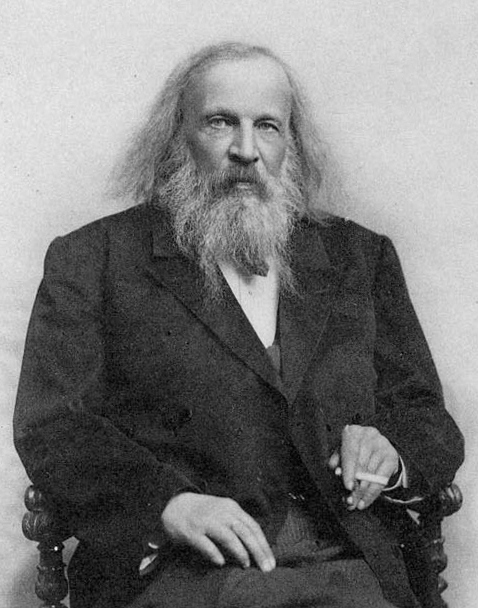
Dmitri Mendeleev. In 1869 he sorted 63 elements on cards and left the wrong-fitting cells empty, then described what belonged in them. The field called it overreach. That verdict had six years to live.
Public domain · Wikimedia Commons
- Saint Petersburg. Dmitri Mendeleev is a chemistry professor stuck on a textbook chapter.
The field has 63 known elements and a pile of patterns. Some are metals. Some are gases. Some explode in water. Some react with nothing at all. Everybody sees the patterns. Nobody has the structure underneath them.
Mendeleev writes the 63 elements on cards. He sorts them by atomic weight, the one measurement his era can actually trust. He lays the cards out and watches the behavior repeat at regular intervals down the sequence. Reactive metal. Heavier metal. Non-metal. Halogen. Again.
So he arranges the cards so the repeats stack vertically. The reactive metals land in one column. The halogens land in another. The structure of all known matter shows up on his desk, in a grid, made of paper cards.
That alone puts him in every textbook forever. He does not stop there.
Where the next card by weight does not match the column it should land in, he does the thing that makes the table immortal.
He leaves the cell empty.
He does not force the wrong element into the wrong column to make the grid look finished. He lets the table say it. Something is missing here.
Then he describes the missing things. For the empty cell under aluminum he predicts a metal with a density of 5.9 and a suspiciously low melting point. He publishes. The field calls it overreach. That verdict has six years to live.
- France. Lecoq de Boisbaudran discovers gallium. Density measured: 5.94. It melts in your hand.
- Sweden. Nilson discovers scandium. It drops into the cell held for it.
- Germany. Winkler discovers germanium. Same story.
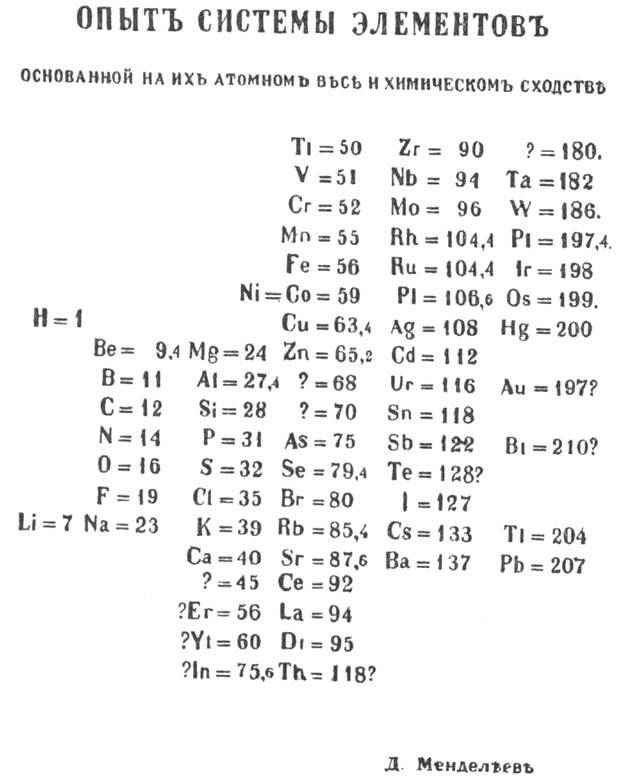
The 1869 table, with question marks where he predicted elements nobody had found. Gallium, scandium, and germanium each dropped into a cell a pencil had marked empty. The structure was the power, not the prophecy.
Public domain · Wikimedia Commons
Three elements. Three countries. Three different scientists. Eleven years. All found in cells a pencil marked empty in 1869.
The field did not just accept the table after that. It surrendered to it.
Then 1894, the stress test. Ramsay and Rayleigh isolate argon. It reacts with nothing. It fits no existing column. It looks like a violation of the entire structure. Mendeleev himself doubted it and argued it away at first. Over the following years Ramsay's lab finds helium, neon, krypton, xenon. An entire family nobody had ever seen.
The grid did not break. It grew a column. The noble gases took the right edge: the inert family that reacts with nothing and bounds everything. The structure absorbed a surprise its own author resisted.
The structure outvoted its author. Hold that thought. It comes back.
Now the correction, because nearly every retelling of this story sells the wrong moral.
The prophecy is the headline. The structure was the power.
Predicting gallium was the party trick. The real result is quieter and much bigger: every element discovered since 1869 has landed in a slot the structure already held. Thousands of chemists. 157 years. 55 new elements. One grid. Nothing has ever landed outside it. Quantum mechanics arrived decades later and explained why the columns work. The explanation changed. The columns held.
That is what a classification is. Not a guess about the future. A shape that stays right when the future shows up.
That is the claim this Table makes. The only claim. Keep it loaded. You will need it when we reach the holes.
“The structure outvoted its author. Hold that thought. It comes back.”
Section III
The Instrument
Open the Table at nexosintelligence.com/academy/table. Keep it next to this page. This module assumes you did.
First impression: it looks like a castle. Nobody styled that. The data drew it.
Eight periods run top to bottom, numbered 1 to 8 down the side. Eighteen groups run left to right, numbered 1 to 18 across the top. Period 1 holds two lone cells, one at each edge, same as the wall chart you grew up with. Periods 2 and 3 rise as towers at the edges with a notch of open sky between them. Periods 4 through 8 run solid, 18 cells wide, the full width of the grid. The last period is ragged. It ends mid-row.
And below the whole grid, detached and marked with a star, sits one more row. People. Your chemistry wall pulled rows out and parked them under the table too. Here the pulled-out row is the humans.
The silhouette teaches before you read a single cell.
The solid middle is settled territory. Typed, named, running in the field right now.
The ragged last period is the edge of the built world. It is supposed to look unfinished. It is unfinished.
The detached People row sits apart because every other family runs through it. We will get there.
Now the cell itself. Every cell carries six things, and the how-to-read-a-cell key sits on the face of the instrument:
The number. 1 to 117 on the live grid.
The symbol. One or two letters. Lf. Cv. Wt.
The name. Labor Forecasting. Covenant Gating. Witness.
The family color. Nine families, nine colors. The color tells you the column's business at a glance.
The load rating. How much weight the function carries when it fires. A load 4 is paperwork. A load 9 can end a relationship, a career, or a company. Only three live cells carry a 9. We will meet all three.
The autonomy level. L1 to L5. L1 assistive: the machine hands you things. L2 partial: the machine does pieces, you drive. L3 conditional: the machine drives inside conditions you set. L4 high: the machine runs it, you audit. L5 fully autonomous: the machine runs it and nobody watches.
Here is your first receipt, and it is the most important number in this module. Count the L5 cells on the Table.
Zero.
117 live functions, and not one runs unwatched. 69 sit at L3, conditional, the fat middle of the scale. 23 run high at L4. 22 run partial at L2. 3 sit at L1, barely touched. The distribution is the honest state of the field in one glance: the machine has earned the middle of the scale. It has not earned the top. Anyone selling you L5 today is selling you the gap between a demo and a deployment.
One more layer. Click any cell and a drawer opens: the full explanation, the load, the autonomy, and every chain the cell belongs to. Click a chain and the Table dims while the chain lights up, stage by stage, badges 1-2-3 across the grid. Esc clears it. Ten chains, 52 cells covered. That trace view is where the Table stops being a poster and starts being an instrument.
Section IV
The Nine Families
Nine columns of business. Here they are, with live counts. The counts are receipts, not decoration: they tell you where the field has done its building.
Financial. 14 cells. Money in, money out, money explained. Forecasting to invoicing. The family splits clean down the autonomy line: the mechanics run at L4 (cost allocation, revenue recognition by the accounting rulebook, cost tracking, variance, invoicing) while the judgment stays at L2 and L3 (pricing, budgeting, capital). The machine owns the arithmetic. The calls that end careers stay yours.
Operations. 17 cells. The biggest family. The daily machinery: email triage, calendars, documents, task assignment, workflow orchestration, inventory, procurement, logistics, incidents. If your day keeps disappearing, this column is where it goes.
Analytics. 13 cells. The read on the field: measurement, pattern detection, anomalies, forecasting, reporting, root cause, scenarios. One warning before the vendors get to you: most of what sells as "AI for business" lives entirely inside this single family. Thirteen cells out of 117. Analytics is a family. It is not the Table.
Sales. 12 cells. Lead to renewal. The most human column in the building, whatever the demo said. Its autonomy floor shows up hard in the chain walk. Sales holds one of the three load 9 cells on the entire grid, and it is exactly the one you think it is.
Comms. 4 cells. The smallest family. External messaging, decision logging, status updates, notification routing. Small because the Table types by what work does, not by what the meeting invite calls it. Most of what people call communication is another function wearing a costume.
Customer. 12 cells. Inquiry to retention. Answering, resolving, escalating, listening, keeping. The tier-1 front line runs at L4. Everything behind it runs conditional, because relationships are not tickets.
Creative. 13 cells. Generation and editing across visual, video, sound, voice, written word, brand, layout, identity. Five of its 13 cells run at L4. The machine drafts fast and cheap now. The taste is still yours, and the Table prices it that way.
Trust. 16 live cells, plus the two holes. The right edge. The noble gases of this grid, and the comparison is structural, not poetic: like the noble gases, Trust does not transform anything. It bounds. It gates, verifies, audits, enforces, and halts. Every other family does work. Trust decides what work is allowed.
Read the split inside Trust carefully, because it is the best single lesson on the Table. Six Trust cells run at L4, high autonomy: Audit, Compliance Monitoring, Policy Enforcement, Access Control, Authorization, Data Privacy. The watchers. A machine never gets bored. So the field gave it the watching. Now the other end: Ethical Review at L1. Kill Switch at L2. Legal Review at L2. Risk Assessment at L2. Dispute Resolution at L2.
The machine keeps the record. The human keeps the conscience. Sounds like a poster until you read the right edge. Then it is just the data.
People. 16 cells. Detached. Starred. Sourcing to succession: recruiting, interviewing, hiring, onboarding, reviews, compensation, transitions, workforce planning. Half the family, 8 of 16 cells, runs at L2. One cell runs at L1: Compensation. Nothing in the entire row runs above L3. The grid trusts machines with invoices. It does not trust them with humans. Correct on both counts.
And now the three load 9 cells I promised: Closing (#71, L1). Kill Switch (#83, L2). Ethical Review (#87, L1). The three heaviest moments an operation has: winning the deal, stopping the machine, deciding right from wrong. All three sit at the bottom of the autonomy scale. Nobody designed that to be profound. The data just came out that way. The heavier the cell, the closer the human. Across the whole grid, that trade holds.
Section V
The Four Orientations
Family tells you where a function works. Orientation tells you which direction it pushes. Four of them.
Value-Side. Create and convert. The functions that make the operation bigger: new leads, new revenue, new work in the world. The direction every founder over-loves and every pitch deck over-counts.
Cost-Side. Relieve and reduce. The functions that make the operation lighter: removing waste, cutting drag, dropping what does not earn its weight. Cost-Side is the least celebrated direction in business and the Table refuses to play along. An operation that removes $50,000 of recurring waste did the same structural work as one that captured $50,000 of new revenue. The grid treats them as equals because they are.
Bidirectional Flow. The functions that flex both directions as demand moves. Staff up Friday, down Monday. Scale for the season, release after. Operations breathe. These are the cells that breathe with them, and they are the work most operators have been doing by feel their whole careers.
Governance. Verify and gate. The functions that bound the other three. What is permitted, what is blocked, what needs sign-off, what gets recorded. Governance concentrates hard at the right edge, in Trust, where the grid governs itself. Overhead is the wrong read. The other three directions get to run fast because this one is watching.
A cell's full address is both axes at once: family column, orientation register. Learn the address and you can place any function you meet in the wild, on the grid yet or not. Vendors will keep pitching you adjectives. You will be reading coordinates.
“Anyone selling you L5 today is selling you the gap between a demo and a deployment.”
Section VI
Ten Chains. Ten Lessons.
A cell alone is trivia. Operations run in chains: the output of one cell is the input of the next. The instrument ships ten of them, and trace mode lights each one across the grid.
One law before we walk. A chain is as autonomous as its least autonomous cell. You can run ten stages at L4 and the whole chain still waits on the one L1 in the middle. The human cells are not bottlenecks to engineer away. They are load-bearing. Plan around them.
Walk all ten. Two get the deep treatment.
WF0. Labor: forecast, actualize, reconcile. The deep one.
Five cells, one family, full loop.
Lf #1, Labor Forecasting. Set the demand assumptions, model the labor need. Ls #2, Labor Scheduling. Build the shifts against the forecast. Lc #3, Labor Cost Allocation. Put every labor dollar where it belongs. Then reality arrives. Vr #12, Variance. Actuals against plan, gap by gap. Ma #9, Margin Analysis. Price what the gap did to you.
Three things to notice.
First, the whole chain lives inside Financial. Some chains cross half the grid. This one runs up and down a single tower. Chains have shapes, and the shape is information.
Second, the autonomy profile: L3, L3, L4, L4, L3. The middle runs hottest. Allocation and variance are arithmetic, and the machine owns arithmetic. The two ends stay conditional: the demand assumptions going in, the interpretation coming out. The machine computes the gap. You decide what the gap means.
Third, the lesson: the chain closes. Forecast, schedule, cost, actuals, reconcile. A forecast that never meets its actuals is not a forecast. It is a horoscope with a spreadsheet. Every chain worth running ends in a cell that checks the plan against what happened. Cell #12, Variance, appears in three of the ten chains on this Table. The grid is telling you something. Listen to it.
WF1. Revenue: project, recognize.
Rf #4 projects the top line. Pr #8 sets price against the projection. Rr #5 recognizes what actually lands, by the accounting rulebook, at L4. Vr #12 closes the loop. The lesson lives in the middle two cells: recognition is rules, so it runs high autonomy. Pricing is strategy, so it does not. Three numbers apart on the grid. A world apart in who drives.
WF2. Cash: position, optimize.
Cf #10 reads the position. Bd #11 sets the budget. Ct #6 tracks spend against it. Co #7 works the drift. Cp #13 feeds the capital plan. Watch the autonomy fall as consequence rises: tracking runs L4, while budgeting, optimization calls, and capital modeling all sit at L2. The machine counts the cash. It does not get to decide what the cash is for.
WF3. Pipeline: lead to cash. Eleven stages, the longest chain on the grid.
Lg #63 generates the lead. Lq #64 qualifies it. Or #65 runs the outreach. Ds #67 runs discovery. Dp #68 demos. Pg #69 sends the proposal. Oj #70 handles the objection. Cl #71 closes. Cx #72 executes the contract. Iv #14 invoices. Rr #5 recognizes the revenue.
Now read the same eleven stages by autonomy. The plumbing at both ends runs L3 to L4: sourcing, enrichment, sequences, proposals, contracts, invoices, recognition. The middle of the chain sags to L2: discovery, demo, objections. And the center bottoms out at Closing. Load 9, L1, the heaviest and most human cell in Sales.
The machine fills the room and clears the paperwork. The human closes. Eleven stages across two families, and the entire chain waits on one handshake. Call that a flaw and you have misread the chain. The automation exists to deliver you, rested and informed, to the one moment that pays for everything.
WF4. Customer: inquiry to retention.
Iq #52 answers tier-1 at L4. Sv #53 resolves. Ch #54 handles the complaint. Ec #62 escalates what needs a human. Fk #58 collects feedback. Ns #59 reads the sentiment. Rn #57 keeps the relationship. The load-bearing cell is Escalation. The release valve is what makes front-line autonomy safe to run. An L4 answering machine with no escalation path is not automation. It is a liability with a chat window.
WF5. Content: draft to verified send.
Wc #47 drafts. Ce #48 edits. Bv #49 holds the voice. Then this chain does something your current marketing stack does not do: it routes through Trust before anything leaves the building. Vf #75 verifies the claims. Cv #82, Covenant Gating, holds the gate. Nothing irreversible passes without a human yes. Only then does Em #90 send.
A send is the cheapest action on the Table and the most expensive mistake. This chain prices that correctly. Two governance cells stand in front of one send button. Count how many stand in front of yours.
WF6. Incident: response to story.
Ir #27 responds, at L2, because when it is actually on fire the human leads and the machine assists. Rt #36 finds the real root cause, not the comfortable one. Do #92 documents what happened. Cc #101 communicates it straight. The order is the lesson: documentation before communication. The story you tell after an incident is part of the incident. Companies run this chain backwards in public every single week. You have watched them do it.
WF7. People: plan to onboard.
Wp #113 plans the workforce. Rc #105 recruits. Iw #106 interviews. Hd #107 makes the hiring decision. Oh #108 onboards. Ep #115, Team Engagement, closes the loop, reading workforce engagement on a steady cadence. Ceiling check: nothing in this chain runs above L3, and the decision cell itself runs L2. The grid will happily automate your invoices end to end. It makes you keep your own hands on the humans.
WF8. Governance: the Control Tower. The other deep one.
On an airfield, the tower owns the runway. Nothing rolls onto it without clearance. Not most movements. Every movement. This chain is the tower for machine action. Four stages, in order.
Pf #79, Policy Enforcement. L4. The machine enforces the written rules on itself. Every action, every time, no fatigue, no exceptions. Holding rules constantly is the thing machines do best, so the grid hands them exactly that.
Cv #82, Covenant Gating. Load 8, the heaviest cell in the chain, at L3. The gate. Machine action pauses here for a human sign-off. Anything irreversible is blocked outright.
Au #76, Audit. L4. The technical record. Every action, timestamped, machine-kept, reviewable the moment anyone challenges it.
And then the chain steps off the built grid.
Wt, Witness. Stage four is a cross-hatched hole in the Trust tower. The predicted cell: operator-readable narratives of what the system did, why it did it, and who approved it. Audit is the technical record. Witness is the story a human can actually read. Audit answers the auditor. Witness answers you.
Sit with the picture. The deepest governance chain on the Table ends in a hole. The structure says the chain is four stages long, and the field built the fourth stage last. That is the honest state of this industry in a single trace: rules, gates, and records are mature. Legibility is arriving last.
The chain's lesson: governance runs as a sequence, not a department. Enforce, gate, record, narrate, in that order. Skip a stage and the other three do less than you think.
WF9. Supply: count to reconcile.
Iy #21 counts it. Pc #22 buys it. Lr #23 moves it. Ct #6 costs it. Vr #12 reconciles it. Same skeleton as Labor: count, commit, move, cost, reconcile. Third chain on the grid to run through cell #12. Chains that do not end in reconciliation are not workflows. They are wishes with steps.
Section VII
The Two Holes in the Trust Tower
Two cells on the Table render as cross-hatched holes, both in Trust.
Pb, Agentic Plug Brokering. Load 9, L3. The function that resolves what services and credentials an agent needs through a governed broker. The operator approves the scope. The system resolves the connections. This is the credential bottleneck on agent autonomy, which is why it carries a 9: an agent that can wire itself into your systems is either the most useful thing you own or the largest hole in your wall, depending entirely on the brokering.
Wt, Witness. Load 7, L3. You met it at the end of the Control Tower chain. The human-legible narrative of machine action: what ran, why, on whose approval. The pair to Audit's technical record.
Now the dates, printed in full, because this is the part where courses like this one usually start lying.
The field built Pb. It calls the category tool and connector brokering, and it shipped as the Model Context Protocol. Anthropic released it on 2024-11-25. OpenAI adopted it in March 2025. Google followed in April 2025. In December 2025 it was donated to the Linux Foundation, which is what happens when something stops being a product and becomes plumbing.
The field built Wt too. It calls the category agent observability and tracing. LangSmith went GA on 2024-02-15. By mid-2025, OpenTelemetry had named the category outright.
This Table was drawn in 2026. Read those dates again.
Every one of them runs earlier. So there is no "we called it" here. There will never be a "we called it" in this course, because the claim dies under one web search, and you should run that search on every vendor who makes it to you. What this Table claims is smaller and better, and it is Mendeleev's real result, not his party trick: take the field's actual 2024-2026 agent infrastructure and drop it onto the grid. Each piece lands in one slot. It touches nothing else. The slot was already shaped right.
MCP lands in Pb. The tracing stacks land in Wt. Clean drops, no redrawing.
Remember argon. The structure outvoted its author. Same law here. The grid does not care who drew it or when. It cares whether new things land in its slots. So far they do, and the holes stay cross-hatched on the face of the instrument. The field's names are printed here, in this module, beside them. The hole is the lesson: the slot held its shape, and the field's own work dropped in clean.
Classification, not prophecy. It is the weaker-sounding claim and the stronger one. Prophecy gets you a headline. Structure gets you an instrument that still works next year.
“The Table is set. Bring your property.”
Section VIII
Column 19. The Proposed Wing.
Look right of the Trust tower. One more column, drawn dashed. Three cells.
Tb, Token Broker. Load 4, L4. Governed budget and credit issuance for agent workloads. Someone has to hold the wallet, and it should not be the agent.
Ar, Agent Reputation. Load 5, L3. The track record of an agent across its runs, feeding authority and promotion decisions. Machines earning trust the way employees do: on the record, over time.
At, Action Attestation. Load 5, L3. A cryptographic receipt that a specific action occurred exactly as logged. Not "the log says so." Proof.
Proposed means proposed. Not ruled, not law, not taught here as settled. The dashed border exists so you cannot mistake these for the grid. If they earn their slots, they get numbers. If they do not, they come off. An instrument that never removes a cell is not classifying the field. It is decorating it.
Section IX
The Living Table
Here is the closing fact, and it is the "learning" in this module's title.
A static table of this field is obsolete the day it prints. You just watched the receipts: an entire category went from first release to Linux Foundation plumbing in 13 months. Autonomy levels are drifting upward right now as the machines earn it, cell by cell. A poster cannot hold that. So this Table does not print and stop. It is maintained, dated, and versioned, and the version is on its face. Cells will move. Levels will change. The holes will fill and new holes will open on the ragged edge. When you consult the Table, check its date the way you check the date on anything perishable. The Table learns. That is the deal.
And you learned the vocabulary. That was the actual work of this module, and it is done. You can read a cell: number, symbol, name, family, load, autonomy. You can read the silhouette: the settled middle, the ragged edge, the starred human row. You can read a chain and find its human cells before they find you. You can hear a vendor pitch and place it: which family, which orientation, which autonomy level they are actually selling versus the one they are claiming. That skill alone is the module.
One thing is missing. Your operation is not on this Table yet.
Module 4 fixes that. You walk your own property with this vocabulary in hand. Every function you run today, every one you run by feel, every one you pay for twice without knowing it. You will put your operation on the grid, cell by cell, and see the whole thing the way you just learned to see the field.
The Table is set. Bring your property.