Opening
The Thesis
One paragraph. Capability is real and cheap. GPT-3.5-level intelligence fell from $20 per million tokens in November 2022 to $0.07 by October 2024. More than 280x in under two years (Stanford HAI AI Index, 2025). Deployed reliability is neither real nor cheap. 95% of enterprise GenAI pilots delivered no measurable P&L impact (MIT NANDA, July 2025). Legal research tools marketed as hallucination-free hallucinate 17-33% of the time (Stanford RegLab, 2024, published 2025). Both facts hold on the same day. The gap between them is the entire industry. Every section below is detail on that gap.
Section I
The Frontier: Fifteen Models Above 96%, Zero Meaningful Rankings
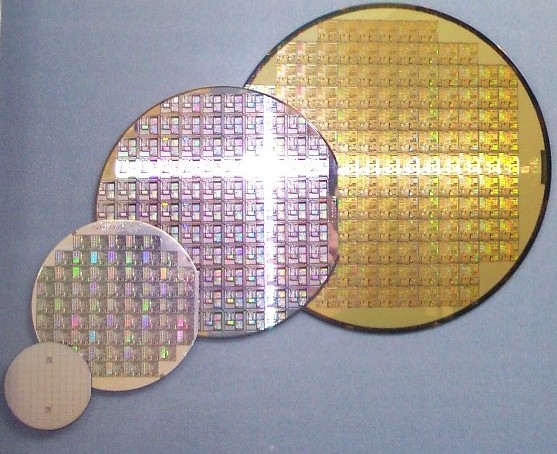
The physical floor under every AI capacity forecast: silicon. Advanced packaging, not raw chips, is the binding constraint, and it is reported sold out well ahead of demand.
CC BY-SA 3.0 · Wikimedia Commons
The labs first. Receipts only.
Anthropic. Haiku fast and cheap, Sonnet in the middle, Opus on top, and a new tier above Opus announced June 9, 2026. Opus 4.5 shipped November 24, 2025 at $5 in, $25 out per million tokens, and the price held through 4.6 (February 5, 2026), 4.7 (April 16), and 4.8 (May 28) (Anthropic model pages, 2026). Sonnet 5 landed June 30, 2026. Context reached 1M tokens in beta. Prompt caching cuts cost up to 90%, batch another 50% (Anthropic, 2026). Claude Code, the terminal coding agent, hit about $1B annualized revenue by November 2025. Company-reported. Read it as such. The friction is on the record too: April 2026 set the monthly record for false-positive refusal reports from Claude Code users. 35 of them (Business Insider, April 2026). Capability up. Patience tested.
OpenAI. GPT-5 launched August 7, 2025 as a router between a fast model and a reasoning model. 400K context. $1.25 in, $10 out (OpenAI, August 2025). Roughly monthly iterations followed. GPT-5.4 (March 5, 2026) added mid-stream reasoning, computer use, and tool search that cut tool-heavy token burn about 47% on Scale's MCP Atlas benchmark. GPT-5.5 (April 23, 2026) is the first fully retrained base since GPT-4.5. Natively omnimodal. 1M-token API context. $5 in, $30 out (OpenAI, April 2026). OpenAI's own numbers for it: Terminal-Bench 2.0 at 82.7%, OSWorld-Verified at 78.7%, FrontierMath Tier 4 at 35.4%. Vendor-reported, and OpenAI itself flags possible memorization on some evals. They flagged their own evals before anyone else could. That buys benefit of the doubt. Nothing more. Internally they report more than 85% of the company uses Codex weekly, and their finance team ran 24,771 K-1 tax forms through it, 71,637 pages (OpenAI, 2026). Also company-reported.
Google DeepMind. Gemini 3 Pro on November 18, 2025 with a "Deep Think" reasoning mode. Gemini 3.1 Pro on February 19, 2026. $2 in, $12 out per million tokens, rising to $4/$18 past 200K tokens (DeepMind model card, February 2026). Vendor benchmarks: ARC-AGI-2 at 77.1%, GPQA Diamond at 94.3%, SWE-Bench Verified at 80.6%. Now the number Google printed that matters more than all three. At the full 1M-token context, its own pointwise MRCR recall score is 26.3% (DeepMind performance table, February 2026). A million-token window that reliably retrieves about a quarter of what you put in it. Window size is a marketing number. Retrieval is the real one. Google printed both. Most buyers read one.
Open weights. DeepSeek V4, MIT license, released April 24, 2026. Near the frontier at prices the closed labs will not match: Flash $0.14 in / $0.28 out per million tokens, Pro $0.435 / $0.87, down from a $1.74 / $3.48 launch price cut 75% and made permanent late May (DeepSeek API pricing table, July 2026). Qwen 3.5/3.6 under Apache 2.0, with GPQA Diamond around 88.4%. Mistral moved Large 3 and Small 4 to Apache 2.0. Moonshot's Kimi K2.6 topped the neutral Artificial Analysis open index in May 2026, and K3 shipped July 16, 2026. Every ranking in this paragraph comes from third-party aggregators, not primary lab cards. The direction holds. The specifics rot by the week, so date-stamp anything you quote from this paragraph. The durable fact underneath: Stanford measured the open-vs-closed performance gap shrinking from about 8% to about 1.7% (Stanford HAI AI Index, 2025). Closed labs are selling a shrinking edge at a premium. That is the structural story of the frontier.
Now the part that kills the scoreboard. On MATH-500, fifteen models score above 96%. The gap across the top five is 0.4 points. Run-to-run variation is 1.3 points. The ranking is not statistically meaningful (LayerLens Q1 2026 Frontier Model Report, 200+ models tested). Epoch AI adds that benchmark overfitting "seems to have become more common since 2024" (Epoch AI, 2025). Epoch's read: labs may be training near the test. A hedged charge, printed as one. Leaderboards became billboards.
So here is the operator move, and it is the first hard assignment of this module. Build your own test set. 300 to 500 examples pulled from your own production data. Your tickets. Your orders. Your documents. Your ugliest edge cases. Run it against every model update before you switch anything (LayerLens Q1 2026, and they are right). A public benchmark tells you what the lab optimized. Your test set tells you what you will actually get. One of those pays your rent.
Housekeeping law for this whole section: minor version numbers rot fast, and some come from aggregators, not the labs. This module re-verifies model names against vendor pages every weekly update. Quote versions with their dates or not at all.
“Leaderboards became billboards.”
Section II
The Agentic Shift: A Standard Port and an Unlocked Door
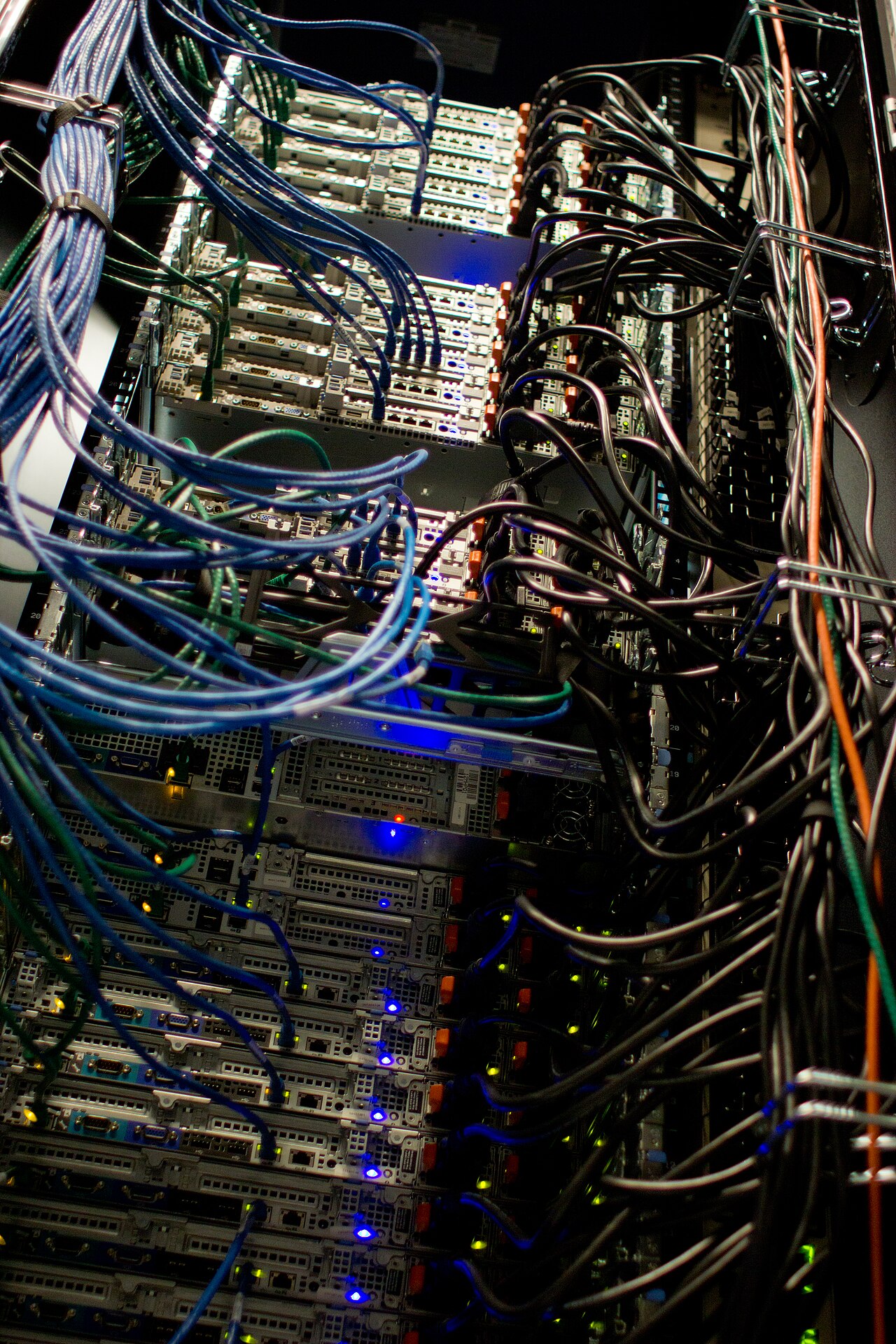
The agent era runs on infrastructure like this, wired to tools and data through one standard port. Every tool an agent can reach is also something an attacker can make it reach.
CC BY-SA 3.0 · Victorgrigas · Wikimedia Commons
2025-2026 is the agent era. Not chat. Action. Models that call tools, hit APIs, and run multi-step jobs. Two things made it real. One thing should keep you up at night.
The port. Model Context Protocol. Anthropic shipped it November 25, 2024. Donated to the Linux Foundation's Agentic AI Foundation in December 2025, with OpenAI, Google, and Microsoft co-sponsoring (Anthropic, December 9, 2025). One standard for wiring models to tools and data. Every client that matters plugged in. Claude, ChatGPT, Gemini, both Copilots, Cursor, VS Code, Zed. Server side: Slack, GitHub, Salesforce, Stripe, Shopify, Notion, Figma, thousands more. The markers that verify: 10,000+ active public servers, 97M+ monthly SDK downloads (Anthropic, December 9, 2025). An independent Nerq census counted 17,468 servers (Q1 2026). Enterprise-managed authorization went stable around July 2026. Anthropic, Microsoft, and Okta behind it, with Asana, Canva, Figma, Linear, and Supabase among the first shipping under it (InfoQ, July 6, 2026). Next spec revision (2026-07-28) goes stateless (modelcontextprotocol.io, RC May 21, 2026). Under two years from press release to industry plumbing. Standards do not win by committee. They win by port count.
The door. At RSA Conference 2026, fewer than 4% of MCP-related submissions framed the protocol as an opportunity (CIO.com, 2026). The security industry looked at the agent era and saw an attack surface. One RSA session demonstrated an MCP vulnerability chain ending in remote code execution and a full Azure tenant takeover. Not theoretical. EchoLeak (CVE-2025-32711, CVSS 9.3, disclosed June 2025 by Aim Security) was the first documented zero-click prompt injection against a production AI system. One crafted email could exfiltrate internal files through Microsoft 365 Copilot. No click. No download. Just an email the agent read. CrowdStrike documented threat actors injecting malicious prompts into GenAI tools at 90+ organizations in 2025, with AI-enabled attack volume up 89% year over year. Their line: "Prompts are the new malware" (CrowdStrike Global Threat Report, 2026). OWASP ranks prompt injection #1 on the LLM Top 10 for the second consecutive edition (OWASP, 2025). One more pair. Hold them side by side. 88% of organizations reported a confirmed or suspected agent security incident in the past year, while 82% of executives believed their existing policies already covered them (vendor-aggregated surveys, 2026, flagged as such). Every tool your agent can touch is something an attacker can make it touch. Wire agents like you wire payroll access. Least privilege. Logged. Reviewed.
Section III
Adoption: Four Numbers That Cannot All Be True
How many enterprises actually run agents in production? Depends who you ask, and the spread is not noise. The spread is the lesson.
- 11%. McKinsey, 2026, via a Q1 2026 compilation. Definition: an agent in production at genuine scale.
- ~31%. S&P Global Market Intelligence, Q1 2026, via the same compilation. Definition: any agent in production. Banking and insurance lead at 47%. Healthcare 18%. Government 14%.
- 57.3%. LangChain State of Agents, 2026. Sample: 1,300+ practitioners who chose to answer an agent vendor's survey.
- 65%. CrewAI, 2026. Sample: 500 senior executives at $100M+ firms, surveyed by an agent company.
Same question. A 6x spread. Nobody is lying, exactly. They measure different populations with different definitions, and the vendor surveys sample people already bought in. The rule you take from this: never trust a bare adoption percentage. Demand the survey, the sample, and the definition. A stat missing any of the three is marketing.
The wider context makes it stranger. 78% of organizations use AI in at least one business function, and GenAI use jumped to 71% (McKinsey State of AI, 2024-2025). Yet only 5.5% attribute more than 5% of EBIT to it. Everyone uses it. Almost nobody books it.
The pipeline numbers are uglier and more consistent. About 88% of agent pilots never reach production (Anaconda/Forrester, 2026, replicated by a16z and an MIT Sloan CIO panel). Only 28% of AI use cases fully succeed and hit ROI targets (Gartner, April 2026, n=782 infrastructure and operations leaders).
So what is real? Named deployments with receipts.
- JPMorgan Chase. 450+ AI use cases in production, targeting 1,000 by 2026, with a reported 20% gross sales increase in private banking attributed to AI tools (CNBC interview with CAO Derek Waldron, June 9, 2026; FY2025 annual report).
- Taco Bell. Drive-thru voice AI in nearly 900 US restaurants, one of the largest consumer-facing deployments anywhere (Restaurant Technology News, July 2026). It got there the honest way. Started in 2024. Inconsistent. Pulled back and rethought (WSJ via Restaurant Dive). Then scaled.
- Amazon. Deployed its 1-millionth warehouse robot in July 2025 across 300+ facilities, with about 75% of global deliveries robot-assisted, plus a generative fleet model (DeepFleet) cutting fleet travel time about 10% (aboutamazon.com, July 1, 2025).
And capability genuinely climbs underneath. Agents hit 66% success on OSWorld, real computer-interface tasks, up from 12% in early 2025 (Stanford AI Index, 2026). The trend is real. The deployment gap is also real. Hold both at once or you are not reading the industry, you are picking a team.
Section IV
Labor: The Water Is Still. The Canary Is Not.
The strongest labor evidence in the field, ranked by source quality.
The Danish null. Denmark linked ChatGPT-adoption surveys straight to national administrative records. About 25,000 workers. 7,000 workplaces. 11 exposed occupations. Result: precise null effects on earnings and hours. Effects larger than 2% are ruled out, two full years after ChatGPT launched. Average measured time savings: about 3% (Humlum and Vestergaard, NBER Working Paper 33777, September 2025). This is not "no effect found because nobody looked." This is no effect found with some of the best labor records on the planet.
The entry-level canary. Employment for workers aged 22-25 in the most AI-exposed occupations fell about 6% between late 2022 and mid-2025 while older workers in the same occupations gained (Brynjolfsson, Chandar, and Chen, Stanford Digital Economy Lab, updated February 2026). The aggregate is calm. The on-ramp is not. If AI eats the tasks juniors learn on, the bill arrives years later as a missing generation of mid-levels. Watch this line every quarter.
Inside firms. Top-decile earners in exposed occupations: within-firm employment down about 3.5% versus the least exposed. Productivity demand buys most of it back. Net effect muted (NBER WP 33509, 2025). And firms are penciling 3.0% productivity gains into 2026 that their own revenue and headcount say have not landed yet (NBER WP 34984, 2026). Gains booked before earned. That is the J-curve. Output lags the spend, then shows up late. Or never. Watch which.
The macro read. Goldman Sachs economist Ronnie Walker, March 2026: "We still do not find a meaningful relationship between productivity and AI adoption at the economy-wide level." Firms report a median 30% productivity gain in two use cases, customer support and software development. AI's net contribution to 2025 US GDP: 0.1 to 0.2 points (Fortune, March 3, 2026, reporting Walker's note). Big inside individual workflows. Invisible in the national accounts. So far.
The synthesis. The International AI Safety Report's 2025 update: "evidence of broader labour market disruption remains limited, with several studies finding no discernible aggregate impact on employment or wages to date."
That is the honest picture. Not "AI took the jobs." Not "AI changed nothing." Aggregate still water. One canary down. Productivity gains real but narrow. Anyone selling you a cleaner story than that is selling.
“Everyone uses it. Almost nobody books it.”
Section V
The Failure Record
This section stays in the course forever. The industry is busy playing slapass about its victories. The failures are where the teaching is. Every entry here is a named study or a named case. Zero anecdotes.
The headline. 95% of enterprise GenAI pilots delivered no measurable P&L impact. MIT Project NANDA reviewed 300+ deployments, 52 interviews, 153 executive surveys (July 2025). The root cause was not model quality. It was a learning gap: organizations that never integrated the tool into how work actually flows. Two findings inside it are worth the whole module. Externally partnered deployments succeeded about twice as often as internal builds, roughly 67% versus 33%. And about 90% of workers were using personal AI tools on their own while the official pilot died. The workforce adopted. The org chart did not.
Deployed hallucination, measured. Stanford RegLab tested the paid legal-research AI tools on 202 queries. Lexis+ AI hallucinated 17% of the time and answered only 65% correctly. Westlaw's AI-Assisted Research hallucinated 33% and answered 42% correctly. Raw GPT-4: 43%. The providers' "hallucination-free" marketing was, in the paper's own word, overstated (Magesh, Surani, Dahl, Suzgun, Manning, Ho, Stanford RegLab and HAI, preprint May 2024, published Journal of Empirical Legal Studies 2025). These are products lawyers pay real money for. Independently tested once. One failed a third of the time.
The reasoning tax. OpenAI's own system card: o3 hallucinated on 33% of PersonQA prompts. Its predecessor o1: 16% (OpenAI o3 and o4-mini System Card, April 16, 2025). The newer, smarter reasoning model doubled the factual-error rate. Capability and reliability are different axes. The industry keeps selling one as the other. Narrow grounded summarization looks rosier. Best model under 1% on Vectara's leaderboard. Then the November 2025 refresh made the test harder. GPT-5, Claude Sonnet 4.5, Grok-4: all above 10% (Vectara HHEM leaderboard, November 2025 to April 2026; Vectara is a RAG vendor scoring with its own detector, on summarization only, flagged accordingly).
The math that governs agents. Reliability in a chain multiplies. It does not average. At 95% per-step accuracy, a 20-step task succeeds about 36% of the time. 0.95^20 = 0.358. At 90% per step, about 12%. This is arithmetic, not a study. It is also the single most load-bearing fact in this module. It is why "the demo worked" and "it runs my operation" are different claims separated by an ocean of engineering.
And measured agent reality matches the math. On tau2-bench's enterprise knowledge track, messy documents and real tool calls, the best model as of May 2026 (GPT-5.5 at max reasoning) passed 37.4% of tasks first try, and only 20.6% reliably across four attempts, on tasks averaging 18.6 documents and 9.5 tool calls (Sierra Research, March-May 2026; Sierra is an agent vendor, flagged, but it is widely regarded as the most enterprise-realistic benchmark in circulation). Independent tau-bench airline runs at Princeton HAL put top Claude models in the mid-50s. The best agents on earth fail roughly half their complex tasks. That is the ceiling as of this dateline. Price it in.
The case law.
- Air Canada's chatbot invented a bereavement-fare policy. The tribunal made the airline honor it and pay C$812.02. "It should be obvious to Air Canada that it is responsible for all the information on its website" (Moffatt v. Air Canada, 2024 BCCRT 149, February 2024). Your bot's words are your words. The first tribunal to face the question said so, and no court has said otherwise.
- Klarna replaced the workload of about 700 support agents with an OpenAI assistant in February 2024. By May 2025 the CEO conceded quality suffered and moved to a hybrid human model: "cost... seems to have been a too predominant evaluation factor... you end up having lower quality" (Bloomberg, May 2025). A rebalancing, not a rollback: about two-thirds of inquiries were still AI-handled after the shift, with roughly $60M in reported cost avoidance and an 853-agent workload equivalent by Q3 2025 (company-reported; read it as such). The lesson is the metric they optimized, not the tech.
- About 74% of enterprises that deployed AI customer-communication agents later pulled them back or shut them down, 81% at firms with mature governance (Sinch survey of 2,500+ decision-makers via The Register, May 13, 2026; vendor-commissioned, flagged). Directionally consistent with everything above it.
- 1,782 legal cases worldwide involving AI-hallucinated content. 1,489 with fabricated citations. 1,228 in the US alone. The growth curve: about 200 in mid-2025, 719 by January 2026, 1,782 by July 18, 2026 (Damien Charlotin, HEC Paris, AI Hallucination Cases Database, verified July 18, 2026). The founding case, Mata v. Avianca, six fake cases and a $5,000 sanction (SDNY, 2023), was supposed to be the industry's warning shot. The count went up 9x in a year instead. Professionals keep signing unverified machine output with their own names. Do not join the database.
The projection filed with the record. Gartner predicts more than 40% of agentic AI projects will be canceled by end of 2027 (Gartner, 2025). A projection, labeled as one. Given the numbers above it, not a wild one.
Section VI
Governance: One Deadline That Matters, Fifty That Might
EU. The AI Act entered into force August 1, 2024 and phases in. Prohibited practices and AI literacy: February 2, 2025. General-purpose model obligations: August 2, 2025. The consequential one: August 2, 2026. High-risk system rules, Article 50 transparency, and actual enforcement all go live. That is two weeks after this module's dateline. General-purpose models placed on the market before August 2025 get until August 2, 2027. Max fines run EUR 35M or 7% of global turnover, a ceiling above GDPR's (Regulation (EU) 2024/1689). One moving part: a "Digital Omnibus" simplification package (adopted November 19, 2025, political agreement May 7, 2026) pushes some embedded high-risk deadlines to 2028 and is still under negotiation. Plan under current law. Betting your compliance budget on a pending amendment is speculation with extra steps.
US. No comprehensive federal statute. A December 11, 2025 executive order created a DOJ task force to challenge state AI laws, ordered FTC guidance by March 11, 2026, and proposed conditioning about $42B in broadband funding on state deregulation. The states are churn. Colorado passed the first comprehensive state AI law in 2024, then repealed and replaced it with a narrower one before it ever took effect (SB 26-189, signed May 14, 2026, effective January 2027). California's frontier-model transparency law took effect January 1, 2026, with its AI Transparency Act delayed to August 2, 2026. Texas and Illinois have their own regimes in force. 29 states enacted AI legislation by mid-2026, down from 39 at the same point in 2025. 36 state attorneys general oppose federal preemption. The Senate once voted 99-1 to strip a state-law moratorium (TechPolicy.Press; Glacis, 2026). Translation for an operator: US compliance is a map, not a rule. Track your states, not the headlines.
What buyers are actually funding. Only about 21% of companies have a mature governance model for agents. 73% name security and data privacy as top concerns (Deloitte State of AI 2026, 3,235 leaders; LangChain State of Agents, 2026). The budget line that exploded is evaluation and observability: 89% of agent teams run observability tooling, 94% among teams actually in production (Deloitte State of AI 2026; LangChain State of Agents, 2026). Read that second number again. The teams that reached production are almost universally the teams watching their systems. That is not a coincidence. That is the survivorship signature. NIST's AI RMF and ISO 42001 are becoming the reference control frameworks (2026). Boring. Do it anyway.
“The spread is the lesson.”
Section VII
The Money: 280x Cheaper Per Token, More Expensive Per Answer
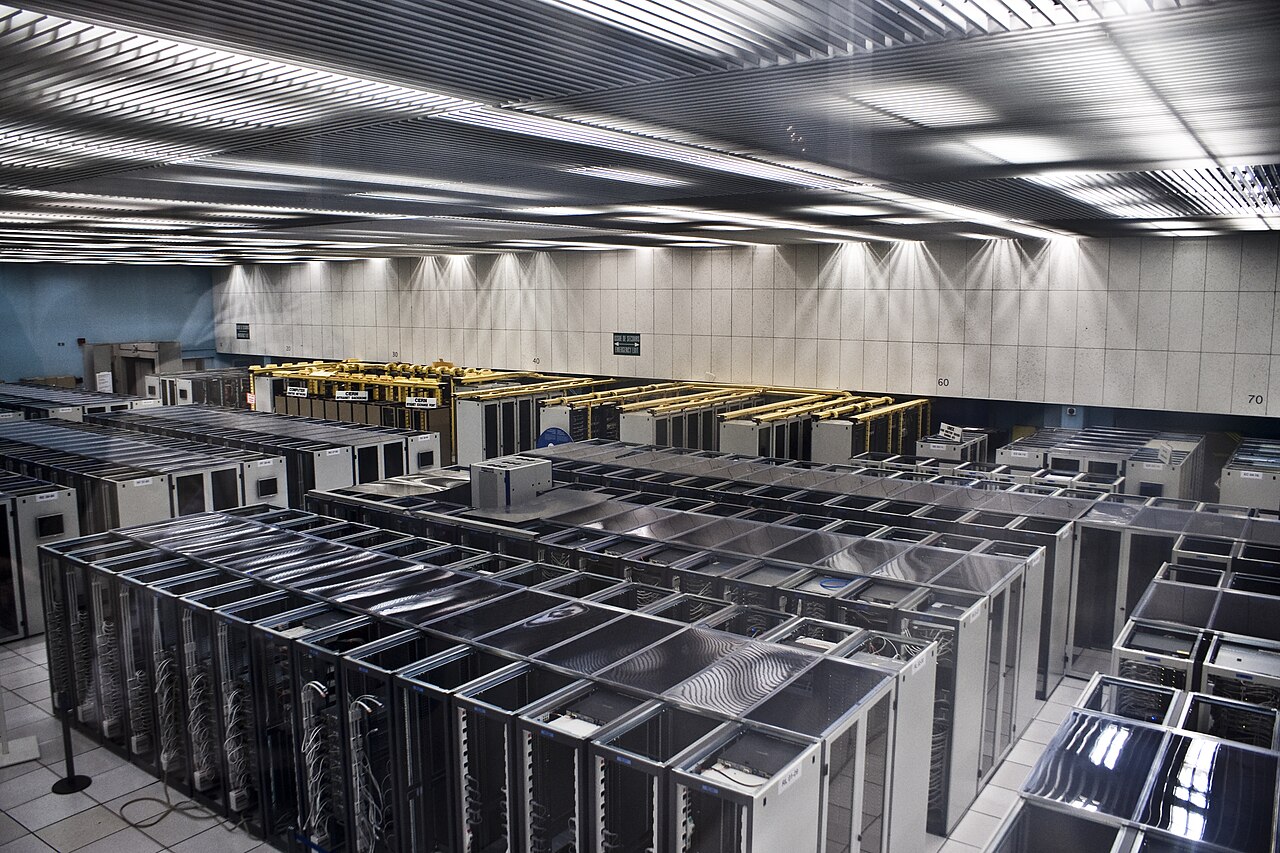
Where the capex goes. Five companies committed roughly $680B in 2026, about double the year before, before the revenue that justifies it exists.
CC BY-SA 3.0 · Florian Hirzinger · Wikimedia Commons
The collapse is real. GPT-3.5-level performance at 64.8% MMLU: $20 per million tokens in November 2022, $0.07 by October 2024 (Stanford HAI, 2025). Epoch AI measured price-per-capability falling anywhere from 9x to 900x per year depending on the task, with the median rate accelerating from 50x to 200x annually (Epoch AI, 2025). Intelligence at any fixed level is a commodity in free fall.
The countervailing force. Reasoning models burn far more tokens per query. Cost per token falls, tokens per answer explode, and cost per query on frontier tasks can rise even while the price sheet says everything got cheaper (Stanford HAI, 2025). Budget on cost per completed task. Never cost per token. Vendors quote the second because it flatters them.
The capex. The five biggest US cloud and AI infrastructure companies committed roughly $660-690B in 2026 capex, about double 2025. Amazon ~$200B. Alphabet ~$175-185B. Meta $125-145B, and its stock fell 9.25% on the raise. Microsoft ~$110-120B. Oracle ~$50B (company Q1 2026 earnings via Futurum Group). Stargate has $400B+ committed toward a $500B, 10-gigawatt buildout, with the Abilene, Texas campus already running (OpenAI announcements, 2025-2026). Double last year's spend, committed before the revenue that justifies it exists. Meta's 9.25% drop is the market doing this section's math in real time. The next paragraph is what the street thinks it adds up to.
The bubble question, with every analysis labeled as an analysis. Morgan Stanley: AI capex-to-sales intensity is about 34% in 2026 versus about 32% at the 2000 dot-com peak. PIMCO: capex could consume about 94% of hyperscaler operating cash flow by 2026-27. Bain: the trajectory needs roughly $500B a year of spend justified by about $2T of revenue, a 4x multiple "not yet demonstrated at scale" (all 2026). Those are named firms' models, not verdicts. Nobody has a read on how this resolves yet. What you can hold: revenue is real and steep. OpenAI went from about $2B ARR in 2023 to a ~$33B run-rate by May 2026. Microsoft's AI business passed a $37B run-rate, up 123% year over year. NVIDIA booked $62.31B of data-center revenue in a single quarter, up 75% (earnings, 2026). And it is still far below the spend. One more flag: run-rate figures are company-reported and contested. Anthropic's April 2026 ~$30B figure was disputed by a competitor's CRO by about $8B on gross-versus-net grounds. Even the revenue numbers are a knife fight. Private valuations are worse. This module quotes none of them.
Section VIII
Four Sectors, One Pattern
Equal standing. Same test applied to each: what is named, deployed, and measured.
Finance. The deepest deployment on record. JPMorgan's 450+ production use cases and 20% private-banking sales lift (CNBC, June 2026). Banking and insurance lead all sectors with 47% running agents in production (S&P Global, Q1 2026). The pattern: heavily regulated industries went first and hardest. The likely reason: they already had the compliance muscle and the data plumbing. Regulation as a head start, not a handicap. That is a read, not a survey result. The surveys measure the lead, not the cause.
Logistics. The quiet giant. Amazon's million-robot fleet across 300+ facilities, 75% of deliveries robot-assisted, a foundation model shaving 10% off fleet travel time (aboutamazon.com, July 2025). Physical automation compounds every year and never holds a press conference about sentience. It just moves your package.
Healthcare. Trailing at 18% agent production (S&P Global, Q1 2026), for defensible reasons: stakes and regulation. Carry this specimen of a zombie stat with you. The "$150B in annual US healthcare AI savings" figure quoted everywhere is a 2017 Accenture forecast about 2026. A decade-old projection, routinely misquoted as a current finding. When you see it presented as news, you are reading someone who did not check.
Hospitality. 26% of restaurant operators report using AI tools. Top use is marketing, 19% full-service, 15% limited-service. Only 6% use it for customer orders (National Restaurant Association, February 18, 2026). The drive-thru tells the whole industry's story in one lane. McDonald's ran voice ordering with IBM from late 2021 and shut it off in test stores by July 2024 on accuracy. Taco Bell started in 2024, hit inconsistency, pulled back, rethought, and now runs nearly 900 stores (Restaurant Technology News, July 2026). Same technology class. Opposite outcomes. The difference was deployment discipline, not the model. Vendor claims in this sector, a 95% accuracy figure here, a 26% phone-revenue lift there, a 90% order-containment stat, are vendor claims until tested on your volume. The hardware math: one source quotes $15,000-$40,000 per lane. Another $3,000-$10,000 up front plus $300-$1,000 a month. The quotes do not even agree on the shape of the cost. And by the trade's own math it does not close for a single-location independent (trade and vendor sources, 2026, flagged). 41% of customers uncomfortable with AI ordering (NRA, 2024). Younger cohorts mind it less. The measured ROI in hospitality is unglamorous: scheduling, forecasting, inventory, phone-order capture. Back of house. In hotels, labor is 51.7% of operating expenses (CBRE, 2026), which is why the AI that pays there touches the schedule, not the lobby robot.
One pattern across all four. The wins are narrow, named, and operational. The failures are broad, vague, and aspirational. Sector does not change the physics.
Section IX
The Next 12-24 Months. All Projections. Every One Labeled.
- Gartner: 40% of enterprise applications embed task-specific agents by end of 2026, from under 5% in 2025 (Gartner, 2026). Same shop: more than 40% of agentic projects canceled by end of 2027. Both projections. Both plausible. Together they describe a shakeout, not a contradiction.
- Deloitte: organizations at moderate agentic use rise from 23% to 74% within two years (Deloitte State of AI 2026). Projection.
- IDC and McKinsey converge on roughly $1.4T of global enterprise agent spend by 2027 (IDC Worldwide AI Spending Guide; McKinsey, 2026). Projection.
- JPMorgan's Waldron: agents running an hour or two, then days, then weeks, starting in 2026 (CNBC, June 9, 2026). A practitioner statement from someone spending real money. Still a projection.
- Restaurant voice-AI vendors say voice becomes "table stakes" within 2-3 years (QSR trade press, 2026). Vendor prediction. Boosterism is the job description.
Nobody selling you a projection invoices you when it misses. Remember that at renewal time.
“Capability is a commodity in free fall. Reliability is a craft in short supply.”
Section X
One Specimen, Under Glass
You will spend the rest of your career reading machine-written text. Learn the fingerprint. The block below is the only place in this entire course where the machine's own voice appears. Labeled. Contained. Dead.
SPECIMEN. MACHINE VOICE. DO NOT IMITATE.
In today's rapidly evolving AI landscape, it's worth noting that enterprise adoption — while still maturing — has arguably reached an inflection point. Organizations may wish to consider leveraging these transformative capabilities as part of their digital journey, though results can vary.
The tells, in order. The dateline opener that says nothing. The throat-clearing before the claim. The em dash, twice, gluing thoughts a period should separate. The hedge stacked on a hedge so no sentence can ever be wrong. "Leveraging." "Transformative." "Journey." Zero numbers. Zero sources. Zero position. A paragraph engineered to be agreed with, never checked. When you meet prose like this in a vendor deck, a consultant report, or a news article, you now know two things. A machine likely wrote it. And nobody was willing to sign a real claim. Both facts are useful.
Section XI
How to Read This Industry Like an Operator
The close. Five rules. They compress everything above.
1. Test on your own data. 300-500 examples from your own operation, rerun on every model update. Public benchmarks are saturated and gamed (LayerLens, Q1 2026). Your test set is the only leaderboard that pays you.
2. Distrust any single figure. Adoption is 11% or 65% depending on who asked whom, with what definition. A number without a survey, sample, and definition attached is decoration.
3. Vendor claims are marketing until tested. Presto's accuracy. Omilia's containment. CrewAI's adoption. Vectara's leaderboard. Some of it is even true. You find out which on your own volume, or you find out in production, in front of customers.
4. Humans stay in the loop. Until an independent benchmark, not a vendor's, shows your task class clearing roughly 90% first-try, a human owns the output. The chain math is merciless. 95% per step is 36% across twenty steps. Long autonomy needs 99% per step or better. Nothing measured today is close on complex work. Best enterprise agent, first try, May 2026: 37.4% (tau2-bench; a vendor benchmark, flagged in Section V). The Charlotin database holds 1,782 cases filed by people who skipped this rule.
5. Watch your product yourself. It's still work. The 95% of failed pilots (MIT NANDA, July 2025) did not fail on model quality. They failed because nobody owned the outcome. The teams that reached production run observability at 94%. They watch. The gap between capability and reliability does not close itself. Somebody closes it. In your operation, that somebody is you.
Capability is a commodity in free fall. Reliability is a craft in short supply. The industry sells the first and needs the second. Now you know the difference, and you know where the receipts are. Work from the future, not the recap. That is the whole trade.
Next module: the map of what agents actually do, and where your own operation sits on it.